
If you are looking for a high-quality rendering service in Melbourne to transform your home’s exterior, protect red brickwork, or modernise an outdated building facade, Dandenong Construction delivers trade-certified craftsmanship built to last. Our experienced local team combines premium Australian-grade materials with proven application techniques to enhance street appeal, boost property value, and safeguard your walls against Melbourne’s unpredictable climate.
From initial substrate inspection to the final protective topcoat, we provide complete residential and commercial rendering solutions across Greater Melbourne and surrounding southeastern suburbs.
Every building substrate requires a tailored approach. Applying the wrong rendering system over brick, lightweight AAC panels, or blueboard often leads to premature cracking, moisture ingress, and costly repairs. We assess your wall condition and match the exact material specification for maximum adhesion and weatherproofing.
Cement render remains one of the most cost-effective ways to cover outdated brickwork, concrete blocks, and rough masonry.
Melbourne’s rapid temperature swings cause standard walls to expand and contract, which can trigger hairline fractures in rigid finishes.
Give your property a distinctive architectural feel with custom texture coats.
Upgrading your home’s insulation starting from the outside is one of the most effective ways to lower energy bills.
Choosing between cement, acrylic, and insulated cladding depends on your budget, existing wall material, and desired aesthetic.
Rendering costs in Melbourne typically range from $45 to $85 per square metre, depending on the chosen material, wall accessibility, scaffolding requirements, and necessary surface repairs.
Cement Rendering: $45 – $65 per m²
Acrylic Rendering: $60 – $85 per m²
Polymer & Specialized Finishes: $70 – $95 per m²
Polystyrene Cladding System (Supply & Render): $90 – $140 per m²
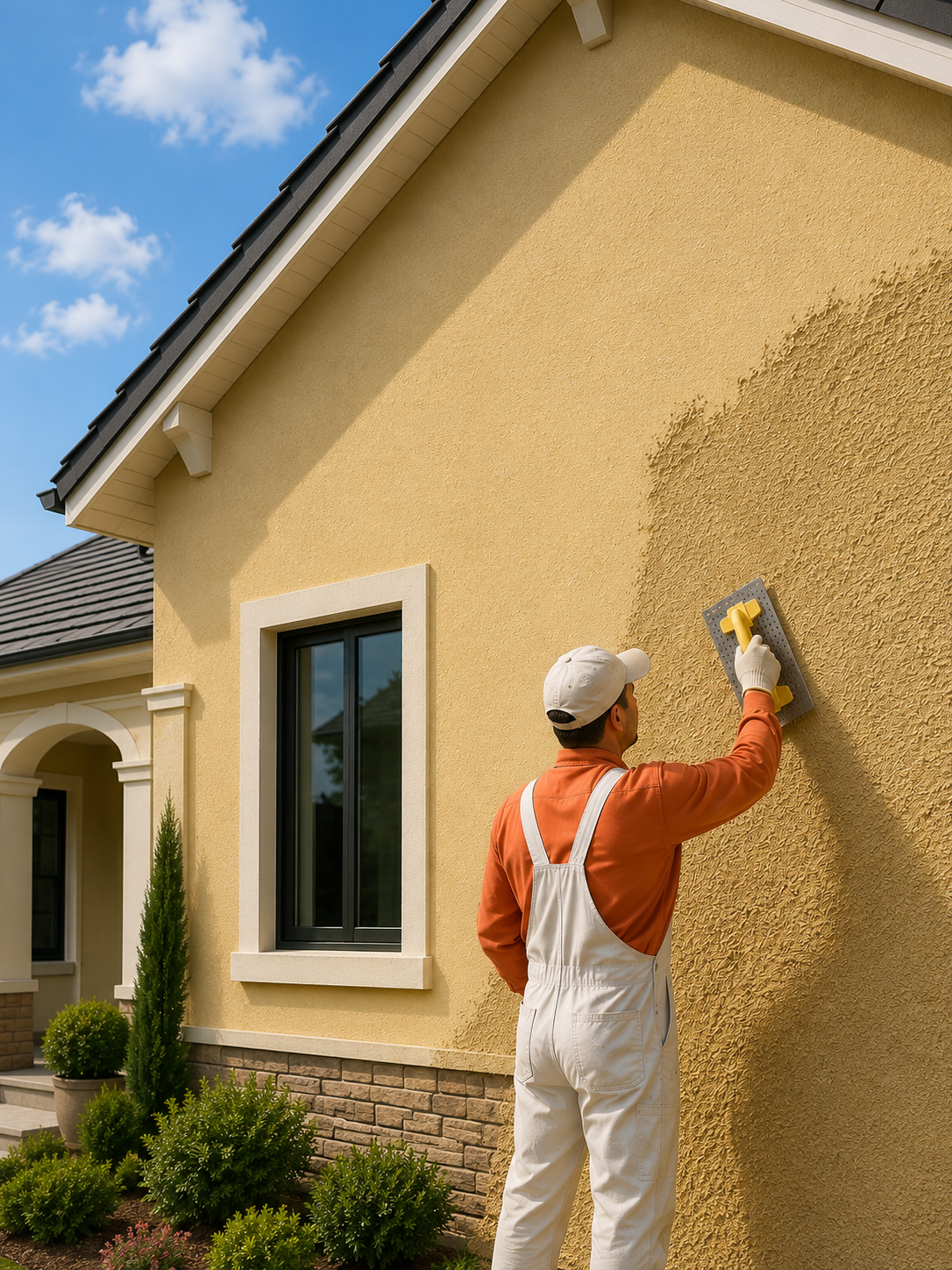
Important Cost Factor: Older brick homes with fretting mortar, severe cracks, or damp issues will require wall stabilization and crack stitching before render application to ensure the warranty remains valid.
We strictly follow Australian Building Code guidelines on every project to guarantee structural integrity and a uniform finish.
Day 1
We wash down all exterior walls to remove dust, moss, and loose debris. Adjacent windows, doors, gutters, and garden beds are fully masked with heavy-duty plastic sheeting and drop cloths.
Day 1 – 2
Structural cracks are stitched and patched using epoxy or specialist fillers. A high-tack bonding agent or polymer primer is applied across the entire surface to ensure strong render adhesion.
Day 2 – 3
The primary base render layer is applied to level out uneven mortar joint lines. Fiberglass reinforcement mesh is embedded around corners, window openings, and key stress points to prevent structural cracking.
Day 3 – 4
Once cured, the second coat of acrylic or cement render is floated and worked with specialized trowels to achieve your preferred finish (smooth, sponge, or coarse texture).
Final Day
After complete drying, we apply UV-resistant elastomeric membrane paint or clear sealer. The site is thoroughly cleaned, masking materials are removed, and a final quality inspection is completed with the client.
Licensed & Fully Insured: Experienced plasterers and renderers operating strictly within Victorian trade safety standards.
Melbourne Weather Spec: We adjust curing times, mixing formulas, and sealant choices to account for Melbourne’s seasonal frost, heavy rain, and harsh summer heat.
Transparent Written Quotes: No hidden charges for scaffolding, site cleanup, or substrate priming.
Premium Brand Products: We exclusively use trade-tested renders and texture systems from leading manufacturers like Rockcote, Dulux Acratex, and RSA.
Explore answers to frequently asked questions to help you better understand.
Cement render is a traditional mix of sand, cement, and lime that is applied over raw brickwork and painted later. Acrylic render contains synthetic resins, making it significantly more flexible, crack-resistant, and capable of adhering to modern materials like blueboard, Hebel, and polystyrene.
When applied by a qualified professional using premium acrylic or sealed cement renders, a rendered exterior typically lasts 20 to 30 years. Regular maintenance, such as high-pressure washing every few years and repainting sealed cement render every decade, extends its life further.
Yes, but you cannot apply standard cement render directly over paint without preparation. Old painted surfaces require mechanical scoring or wire-brushing, followed by a specialized polymer key-coat bonding agent or acrylic render designed for non-porous surfaces.
Standard cement render is water-resistant but porous. To make rendered walls fully waterproof, renderers apply an acrylic topcoat, elastomeric membrane paint, or silicone-based clear sealant to block driving rain and rising moisture.
In most Melbourne local councils, rendering existing brickwork on a residential property does not require a building permit unless your home is subject to a strict Heritage Overlay or specific neighborhood design guidelines.
Call Now